Sunday, 13 September 2015

Out Of My Head


Before I started out on this journey, Manchester was something of a mystery to me.  My perceptions of it were mainly shaped by television - Coronation Street and Queer as Folk - and the occasional visit to the city centre.  Even then, it was a fragmented image - the city centre exists as separate spaces, not one whole, and I frequently lose my bearings there.  The suburbs?  I assumed they were all Weatherfield-style terraces.

What I have learned over the last few years of travelling is that Manchester is far, far more attractive than Corrie suggests.  I've encountered hardly any streets of back to back terraces.  They were mostly done away with in slum clearances and replaced by jagged modernist homes made out of concrete and grey brick.  Instead I've found large suburbs of fine Victorian homes that would be sold for silly money in London.


Now admittedly Davenport is in the "leafy Cheshire" part of Greater Manchester, not far out from Stockport and valuing its SK postcode.  It's Alderley Edge rather than Moss Side.  It's still under TfGM, though, and its station was a neat little suburban halt, with a tiny ticket office on the road bridge.


Opposite was a row of shops: an optician, a barber, a Chinese takeaway that proclaimed in large letters Food Safety Award for Hygiene.  It was the kind of notice that immediately made me uncomfortable, drawing attention to the fact that it's clean and hygienic as though that's something to boast about and not an absolute minimum.

Beyond was a tree lined main road, its original houses now mainly nursing homes, speckled with blocks of square flats.  A 1960s Mormon church with a steel spire; a pub called the Jolly Sailor.  The smaller houses had paved over their front yards so they could accommodate tiny city cars, including one genuine VW Beetle with FAB in its black-and-silver number plate.


A turn and I was on a quieter road, full of semi-detached homes and grass verges.  A pensioner gave his lawn its last cut before winter; a mother slowly walked a tiny toddler in a floral cardigan and neon pink wellingtons.  The homes were turn of the century villas, built for clerks commuting into the city,  and I couldn't help but admire the care and detailing that was put into each one.  Different coloured bricks around windows, terracotta tile work, wooden roofs over the front doors with intricate supports.  Tiny details that just made it so much better and more desirable.  Where there was a more modern infill, it looked even more out of place with plain faces and steel garage doors.


I was at Woodsmoor station before I knew it.  It was tucked under the railway bridge, only opened in 1990 to provide access to the nearby hospital, and it came with the most basic of ticket offices.  It was a Manchester cousin of the one at Kirkby.


The office is only open between 07:10 and 10:10, the kind of perfunctory service that makes me wonder if it's worth providing at all.  Nature has taken over the ticket hall from behind.  If it was built now, this would be proclaimed as an eco-friendly "green roof"; since it was built in the late 80s, we'll just call it Revenge of the Triffids.


I'd not realised how close Woodsmoor was to Davenport, so I was left with plenty of time to kill in the little shelter (after the obligatory sign picture, of course).


I opened the BBC iPlayer Radio app, a piece of genius which more than justifies the licence fee all on its own.  Almost every radio programme the Beeb puts out, ready to be downloaded and kept for up to a month: it is absolutely wonderful.  My phone is now stuffed with comedies for me to enjoy at any time, and I'd saved the last two episodes of In and Out of the Kitchen for this trip.  Miles Jupp is utterly adorable as Damien Trench, and the episodes detailed his stag do and his wedding to the lumpish Anthony, played by Justin Edwards.  I am hopelessly in love with Damien, and frankly, Anthony doesn't deserve him.


A little emotional at their eventual nuptials, I got on the train and went two stops to Middlewood station.  It must be the most accurately named station on the map.  I stepped onto a silent platform surrounded by whispering trees.


Middlewood is, quite literally, in the middle of a wood.  There's no road access at all.  The only way to reach it is through thickly forested paths.


The station owes its existence to the fact that it's the spot where two lines crossed.  The Manchester-Buxton line was the lower station; up top, on the Macclesfield, Bollington and Marple Railway, was Middlewood Higher Station.  That's long gone.  The line closed in 1970, and when I climbed up the steps to the top level, I found a wide empty trackway and an inadequate station sign.


The trackway continued either side of me, its generous size meaning there was a separate lane for horses.  I turned south, crossing back over the still-running railway line and plunging deep into the woods.


Almost immediately, a bug flew into my mouth.  I retched and tried to get rid of it, but one of my many charming defects is my inability to spit.  I've just never managed it.  The ability to bring up a big ball of spittle or phlegm and project it across a distance - I can't do it.  All I can do is sort of flob, pathetically, letting a big wad of gob fall out of my mouth.  I did it now, drooling all over the grass, and eventually managing to cough up the by now drowned corpse of the insect.  In the process I'd lost about four pints of water from my body, but at least it was gone.  (I also can't whistle or catch and I have a tendency to trip over my own feet; it's a miracle I've lived as long as I have without being put in some kind of home).

I left the Middlewood Way and walked behind a stable to the main road.  It was at least fifteen minutes to the street; I wondered why they even bothered keeping it open.  It was clearly far more hassle and expense to close it.  It wasn't like you could get a decent park and ride going.


The road double backed towards the railway line, taking me into the wood.  I was shrouded in cool green.  The leaves were starting to turn Autumnal at their tips, but for now, I had the last gasps of summer.  The pavement gave out, and I walked in the gutter of the road, wedged up against the fence every time a car came round the corner.  Below me a stream trickled and danced.


After being almost mown down by another truck, I was happy to see some steps rising up on the opposite bank.  Ah good, I thought: a public footpath.  Turned out it wasn't a public footpath though, but was instead a sort of compromise footpath: a deal brokered between the council and the landowners.


It was good to be away from the cars, anyway.  The path went further up the hill, in amongst the trees; I had to brush thorns and ferns away to get through.  It was as if they were trying to reclaim the route, now that the prime walking season was over.  Little arrows ensured I stuck to the correct route, each one marked Permissive Footpath.  A permissive footpath has very different connotations - it sounded like the kind of walk where you should be naked and smoking a joint.  "It's a permissive footpath, man!  Anything goes!"


I was finally deposited back on the road at a stone bridge.  Crossing it brought me to an exposed section of cobbled road, and then, a little further on, one of the loveliest level crossings I've ever seen.


That elegant styling!  The green and white colour scheme!  It was adorable, and even more so when I crossed over for a closer look.  Norbury Hollow (a lost Harry Potter location) is a manually operated level crossing, and inside the cabin I could see the guard.  He was leaning back in his chair and reading a book, and I was astonishingly jealous of him.  Such a peaceful, tranquil job, just nipping out now and then to close the gates; the rest of the time just you and your thoughts and a library of books to keep you entertained.  I might have had to get wi-fi installed, though.


A couple more corners, and I left the serenity of the woods to arrive at the busy A6.  The change was stark and shocking.  Trucks and cars peeled past, noisy, their engines suddenly unbearable after the peace of the last hour.  It was ugly and relentless.


Just south of Hazel Grove a worksite had been set up for construction of the south east Manchester relief road, a brand new dual carriageway designed to take traffic for the airport away from the streets.  It was at its earliest possible stage - a quick glance at the website reveals that they're mainly catching Great Crested Newts right now to relocate them - but there were still diggers and trucks and men in hard helmets.


The residential fringes of Hazel Grove turned into busy commerce.  A police station, a garage with a Subway and a queue out the door, a hairdresser's with the charmless name Short n Curly.  Yeah, make people think of pubic hair whenever they walk by; that sounds like a great idea.  A wide expanse of tarmac had been given over to a park and ride facility - the city's first privately funded one, in fact, paid for and built by Stagecoach for the benefit of their buses (25 minutes into Stockport, 65 minutes into Manchester).  Nice idea, but it was pretty much deserted; I can't help thinking building it near the railway station (10 minutes into Stockport, 23 minutes into Manchester) might have been a better way to get cars off the road.


Hazel Grove itself was a stream of takeaways, cafes and grey-faced solicitor's offices.  Perhaps it was the sudden change from Middlewood, but it was starting to get to me.  My head was fuzzy and starting to ache.  I felt overwhelmed, like the town was starting to pile onto me.  I stopped at a McDonalds for lunch, the best, cleanest option I could see, and had an "Italian Classic".  Why is it that, no matter what your order in McDonalds, it tastes like a Big Mac?  The Italian Classic supposedly contained pepperoni, but I couldn't taste it: all I got was the stodgy beef.  And Coke Zero from concentrate is weedy and underflavoured.  Nice fries though.


The back streets, away from the main road, were a little better: small workers' cottages and terraces.  Sixth formers with their ID badges on lanyards round their neck walked round in clusters, idling, killing their lunch hour by wandering round and round.  The station was sited opposite a huge, ugly church, surrounded by a car park and a bus exchange.


The station building was red brick, with the usual GMPTE gate left open to save the station staff the hassle of checking the tickets.  The man in the ticket office was chatting loudly to a man from Securicor, apparently about some fight he'd been in.  I was glad I already had a ticket because no-one seemed to be in any rush to do any work.


There are trains every half hour to Hazel Grove, but only every other train continues on to Buxton, so I took a seat in the tiny terracotta tiled waiting room.  I felt tired and achey; my head was now pounding.  I should have hunted out a pharmacy and got some aspirin, but I just wanted to be quiet and not move for a while.


The train came and took me away over deep valleys to Disley.


The station building wasn't much, just a shelter really, but it was neat and well-kept, and a Scout hut right behind it was a charming addition.  Anywhere with a Scout hut can't be bad.


On the overbridge, a fingerpost guided new arrivals to the National Trust's stately home at Lyme Park, but I went in the opposite direction, towards the village centre.


I should have been charmed by Disley; on another day I probably would have been.  There were pretty limestone buildings in the centre, a war memorial, a fountain erected for the benefit of public health by a distinguished Victorian.  Scenic pubs and trees and floral displays.


I was just in a bad mood, and Disley's perfection was too much.  Instead of capturing my attention, I found it cloying and excessive.  It was like a village from The Avengers, set up by Soviet spies to train them at fitting into English society; a stage set instead of a place for people to live.  Not even the presence of a pub called the Dandy Cock could cheer me.


Leaving the village, things became a little less perfect, and a bit more suited to my foggy brain: a building site, a closed shop (bafflingly, Design a Sausage couldn't make it work), a closed pub.  Sadly, instead of the entreaties from the brewery to make your dreams come true by running your own pub, The Crescent Inn had been sold as "land".  I assumed the building was destined to be demolished, and the idea of the etched glass windows being smashed in some skip made me downhearted.


The sight of a gold post box cheered me immensely.  It commemorated the cyclist Sarah Storey, and I was surprised by how happy it made me.  Must be that spirit of 2012 still running through my veins.  I seem to have developed something of a post box fascination without realising; only the other day I went hunting for a rare Edward VIII post box in Birkenhead's North End.  Perhaps I should start collecting post boxes when I'm done collecting train stations?  That sounds like the kind of hobby that would make me even more fascinating at parties.


I left the main road and headed down a steep hill to the canal, past a noisy development of "luxury homes" (just once I'd like the sign outside to say "we're building a load of shitty boxes that are too close together, but you'll buy them because it's in a nice village").  Through a kissing gate, and I was waterside.


The transformation was fast and wonderful.  Suddenly I couldn't hear traffic; all I could hear was birdsong and the occasional quack.  My feet crunched on gravel instead of hard tarmac.  My shoulders relaxed, and even my headache seemed to slip down a notch.


The Peak Forest Canal is one of the highest in Britain, and now and then I'd get glimpses through the trees into soft valleys.  I was almost floating above them, peaceful, serene.


Occasionally I'd encounter another human being.  A pair of sprightly dog owners.  An old lady with shockingly red hair, clearly from the Cilla Black Memorial Collection by L'Oreal.  A professional stroller in shorts and hiking boots and floppy hat, a carbon fibre walking stick grasped firmly in his gnarled hand.  But most of the time I was alone, and it was lovely.  I strongly suspect that if there was an I Am Legend-type extinction event that wiped out humanity, I'd be perfectly ok with being the last man on earth.  Other people are overrated.


Something changed in the air.  Not the weather, but an actual, physical change.  I could taste it.  It tasted of... liquorice, which was a shame, because I don't actually like liquorice.  But then that taste became overwhelmed by another, the strong, sweet tang of fizzy confectionery.  I realised it was coming from the building at the side of the canal, and I made a connection.


The slightly ramshackle collection of buildings was the factory for Swizzels-Matlow, and what I could taste in the atmosphere was a mash up of Love Hearts, Refreshers and Drumsticks.  Needless to say, my mouth was watering.  I eagerly clambered up onto the road, hoping to find a factory shop selling rejects.  Big bags of cracked Swizzels for a fiver.  In a terrible commercial decision, however, there wasn't anything like that; the factory was strictly business only.  I trudged away sadly, my craving for a mouthful of One Direction Love Hearts unsatisfied.


I'd reached New Mills Newtown far too early for my train, so I had a bit of a wander round in search of some entertainment.  Oh, alright: I was looking for a pub.  Sadly it looked like this end of town didn't any provision for semi-alcoholics.  The one opposite the station had been converted into flats, and The Swan's sign promised much and delivered little.


If I'd been there a few days later, I could have seen Toyah, who playing the local theatre.  She got a better poster than Eddi Reader; I'd spotted a bit of A4 wrapped around a lamp post promoting her July appearance.  Eddi Reader, for the benefit of younger readers, was the lead singer of Fairground Attraction in the 80s, and she once won a Brit Award as Best Female Artist in what we can safely assume was a very bad year for the ladies.  She's no Toyah, put it that way.


My options for entertainment in New Mills seemingly exhausted, I circled back to the station.  It's got a fine British Rail logo sign:


...but the actual station name is a bit rubbish.


I crossed the car park, then clambered over the rusting footbridge to take a seat in the shelter.  It was cool and dark in there.  Once again I was isolated and away from the rest of the world.  It was great.


Sunday, 6 September 2015

Heroes and Villains


I returned to Knottingley amidst a summer rainstorm.  It was sudden and heavy, the first shot of autumn being fired across the bows.  I'd not got a coat so I hid in the shelter and hoped it'd pass before I had to walk between stations.

A train came in at the opposite platform, depositing the last of the rush hour's commuters, and they scurried across the footbridge with coats over their head.  Then I was on my own again, until the Goole train came in, that one evening service.


It was easily one of the filthiest trains I've ever been on.  There was litter everywhere, on the floor, the seats.  I guessed that it had been defiled by schoolkids, bored in the last weeks of the holiday, celebrating their day out in Leeds by making life a little bit shittier for everyone else.  I found a rare seat that hadn't been violated for the trip to Whitley Bridge.

En route I saw something I don't think I've ever seen before: an actual working coal mine.  I've traveled all over the north and all I've seen are legacies of the mining industry.  Abandoned husks of towns, working men's clubs, the odd piece of preserved machinery.  This was a real mine though, with mountains of black crisscrossed by conveyor belts.  Of course, it's also marked for closure, and come January it'll be gone.


I got off at Whitley Bridge with one other person, a young woman who'd moved carriages when I'd got on the train at Knottingley.  I'm being charitable and assuming that she'd moved because she didn't want to be in an empty carriage with one man in case I was a sexual pervert.  Either that or I have a massive B.O problem.


I set off into the village at a super-fast pace.  I had just over an hour to get to Hensall, the next station along, or I'd miss the one and only train back to Knottingley.  I didn't fancy being stranded at the station.  At least the rain had stopped.

A better name for the station would be "Eggborough"; that's the name of the village nearby.  I walked by pebble-dashed local authority houses, some of them with their doors open to let a breeze through.  The heft of a brick flour mill blocked out the sky; next door was a new development of "executive homes".  I bet the owners thought living next to a mill was charming, right up until that one in Cheshire exploded earlier in the year.  Suddenly every odd grind of machinery coming from next door will be tinged with tension in case you're about to get brained by your own front window.


I turned right in the village centre - a couple of pubs, a Spar, a car showroom - and got my first glimpse of the cooling towers of Eggborough power station.  Eggborough, and its near neighbours at Ferrybridge and Drax, would be the reason for that coal mine continuing into the 21st century.  They're also the reason for the Goole line persisting, despite the criminally bad passenger service.  The line's there to bring fuel to the power stations, and human cargo is unimportant.


All the signs for Drax power station of course made me think of (Sir) Hugo Drax in Moonraker, because I am nothing if not obsessed.  Ian Fleming, being the magpie that he was, probably saw the village's unusual name and filed it away; the power station came after his death.  It gives the road signs an unintentionally sinister air - to me anyway.  It was hard not to see them and imagine that Drax was somewhere nearby, surrounded by beautiful women and building a new space station.


The Drax of the novel is one of Fleming's best villains, but Michael Lonsdale in the film is actually even better.  He's incredibly sinister and measured, each utterance half-whispered and dripping with menace.  It helps that he's got some of the best evil dialogue in the series: "Look after Mr Bond.  See that some harm comes to him," and "you appear with the inevitability of an unloved season," are absolute joys, and his grandiose speech to his perfect physical specimens on board the space station is pure brilliance.  I read the autobiography of the film's writer, Christopher Wood, and he dismissed Lonsdale's performance as tedious and one-note.  He could not be more wrong.


I passed over the power station's goods line, walking on the grass because there was no pavement.  Normally the only traffic I see on country roads are speeding cars, but this one was heavy with trucks.  I was glad there was room for me to walk on the verge, because I didn't fancy dodging them in the road.


The factory for Saint-Gobain glass cause me to shudder involuntarily.  We recently got new windows, and the BF is always incredibly thorough when it comes to home projects.  Any large purchase is researched extensively, with a heavy reliance on spreadsheets and analysis.  The usual result is that by the time we actually get the new item, I am sick to the back teeth of talking about the bloody thing, and I never want to hear about it ever again.  Saint-Gobain's sign brought back unwelcome memories of lengthy discussions about acoustic glass and triple glazing and their manufacturing process versus Pilkington's and oh God make it stop.


Could that shot be any more like a Britpop album cover?  Roughly 80% of the music produced in the mid-90s had a slightly depressing image on the front, with a bitingly satirical instrumental about the suburbs on the B-side.  In fact...


Coming to an Our Price near you!

There was a quarry, with a sign outside warning Danger!  Quarries are not a play area!  Frankly, I think children who have to be told that should be allowed in.  Thin the herd of some of the less intelligent kids before they get old enough to spawn.  I was fortunate, a little further on, to catch sight of a Guinness World Record holder: the ugliest house in England.


I assume the enormous lawn is for the protection of passers by, rather than for any aesthetic reasons.

A little further on was a level crossing; I'd have to pass over the railway then double back to get to the station.  Next to it was a speed camera, but behind that was a curiously sleek post.


Closer inspection of its twin across the tracks revealed it was actually a Network Rail camera.  I presume it's there to monitor the safety of traffic passing over the crossing, and also to provide us with hilarious YouTube videos when a Ford Fiesta gets trapped and is then scythed in two by a goods train.  I like the design though; far more attractive than the boxy police camera, as if Apple did surveillance devices.  If we're going to have cameras watching our every move, let's at least make them pretty.

There was a stable around the next corner, with a couple of horses and, incongruously, a llama.  It stopped in its tracks and stared at me as I passed.  Is there a haughtier looking animal than the llama?  It's got a permanent face of judgement, like Margo Leadbetter in a fur coat.  While the horses carried on trotting round their paddock, the llama just watched me, making sure I passed without doing anything common.


I really want to live in Great Heck.  It's like something Minnie the Minx would shout in the Beano.  "Great heck, that was a smashing pile of mashed potato with sausages poking out of it!"  

Hensall's Station Road had some new houses, squeezed onto a tiny plot, and a playground.  There was one of my favourite features outside it, a village notice board, with the minutes of the parish council and a poster for the Hensall carnival on Bank Holiday weekend.  There was a bit of a design whizz on the committee, it seemed; a simple call for tug-o-war teams had been turned into a Soviet propaganda poster.


I fell in love with Hensall station at first sight.  It helps that it's one of those lonely, virtually unused stations that mean I can temporarily claim it for my own.  I'm always pleased to give a station a bit of life.  I like to imagine that somewhere at Network Rail, a little counter trips over one spot with my arrival.


More joyously, the owners of the Station House have embraced their railway location and turned their home into a tiny museum.


Not only was it a charming home, well-looked after, but they'd decorated with period appropriate tin signs.  I was annoyed that I was on the wrong platform, and couldn't inspect them properly.


Even better, that station clock actually worked.  I wanted to knock on the door and tell the residents how great they were.  Bless you, Hensall station house owners.  You're doing God's work.


Wednesday, 2 September 2015

The Long Way Round

Dear Railways of the United Kingdom

Hi!  Scott the Merseytart here.  Big fan.  Pumped loads of money into you over the years - hope you're grateful!  (How about some freebies?)

I'm writing because sometimes, now and then, you annoy the hell out of me.  I hate to criticise, because criticising the railways is lazy and reductive.  We complain too much in this country; we complain about the railways and the BBC and the NHS because one part of it annoys us, and let a huge amount of good stuff just trot by.  We'll spend day after day, week after week, catching a service that arrives on time and is fast and goes where we want to go, but the one time there's a broken down train the British rush to shout "Typical British Rail!  What does my season ticket money pay for, eh?"

But a recent trip to Yorkshire provoked feelings of resentment and anger towards you, and I'm going to have to vent them here.  Don't take it too personally; I love you really.  You could just be a bit better.

Compared to other stations around Goole, Saltmarshe is positively overburdened with trains.  The Sheffield-Hull trains don't all stop there, but there are enough trains in the peak hours to constitute a relatively good service.  There's no need to spend eight hours in the pub, put it that way.

Regular readers will know I like to walk to and from stations; I visit them both as a pedestrian and as a passenger.  And here, railway bosses, is where I encountered my first problem of the day.  Getting from Goole to Saltmarshe on the train takes five minutes:


Walking, on the other hand, takes two and a quarter hours:


The simple reason for this is the river Ouse, looping around Goole.  I accept that it's expensive to build bridges, particularly footbridges over major rivers.  But there's a railway bridge right there.  Railway companies: can you not string a little footbridge along the side for us walkers?  We're no bother.  A footbridge on the side of the rail bridge would have cut out that huge diversion for me.


Instead, I got up a 5 AM so I could get to Goole for the first train to Saltmarshe.  It was an astonishingly pretty morning.  Pink and yellow streaked the early skies.  It almost made me sad to leave.  My train slowly pulled out of the station, burdened with dozy commuters, then crossed the aforementioned bridge:


See?  Just a little footbridge.  Nothing fancy.  Right there.

Across the way I was deposited at the idyllic country station of Saltmarshe.  Close your eyes and imagine what a station called Saltmarshe should look like.

Signal box?


Level crossing?


Acres of fields and no sign of life?


Check, check, check.  On that morning, peaceful and sunny, it was exactly where I wanted to be.


I went and sat in the brick shelter on the platform to eat my breakfast: a bag of Haribo Tangfastics.  I'm not a big fan of Haribo, largely because of their truly awful adverts, and Tangfastics are not tangy enough for me (you're reading the work of someone who has to put three Extra Strong Mints in his mouth at once to get any kind of buzz), but I'd bought them in Slaith while under the influence of all those pints.  They were ok, a bit bland, but at least the sugar buzz stopped me from dozing off.


Not long before the train to Gilberdyke arrived, a young woman joined me in the shelter, reeking of perfume and resentment at being up so early.  She applied mascara as her stomach rumbled.

Here's my second complaint, Network Rail: I wanted to get from Saltmarshe to Pontefract Baghill.  Here it is on a map.


The two stations are in vaguely the same solar system.  The only way I could get there, though, was to travel from Saltmarshe to Gilberdyke, then wait an hour.  Then a train from Gilberdyke to York, to wait another hour.  To kill the time, I bought a chicken wrap from a trendy food place on the platform; only on eating it did I realise it was gluten-free, and I suddenly got an insight into why people with food intolerances can get so angry.  Finally, having spat most of the wrap into the bin and bitterly regretted not spending my four quid at Burger King where at least my low expectations are met, I was on board my third train to Pontefract Baghill.


Is this any way to run a railway, eh?  An as-the-crow-flies journey of 25 miles turned into a lengthy trip of more than double the distance?  Hours after I'd left Saltmarshe, I was finally able to unfold onto the platform at Pontefract Baghill.


Remarkably, for a town of its size, Pontefract has three stations, all relatively close to one another.  I'd already visited the magnificently named Pontefract Tanshelf, which serves the racecourse.  Baghill is on one side of the town centre, and Monkhill is on the other side.


Baghill still has its buildings, but in that kind of twist of fate that exists in real life but would be laughed out of a script conference, the station is now a driving test centre.  Clumsy symbolism alert!


It's no looker, but it has a simplicity that's quite appealing.  I made my away across the tarmac, behind a nervous test subject who was taking way too long to get her Micra out onto the main road, and headed into the town.


I had an idea of what Pontefract was going to be like.  I'd only skirted it on my last visit, and I was looking forward to visiting a historic town with a castle and plenty of ancient buildings.  A sort of Chester, or Warwick.  Instead, I saw this.


High rise flats stacked into the hillside.  Behind them, more flats.  I was confused.  Surely these were the exception?  There were prettier, older buildings behind?


I walked around them, staggering up almost vertical slopes, and found... more of the same.  Pontefract wasn't the gem of West Yorkshire I'd expected it to be.  It was another ordinary, dull little town, another place with a redbrick precinct and a Farmfoods and a load of pound shops.  The streets had properly medieval names - Horsefair, Beastfair, Cornmarket and, I'd spotted on the map earlier, the amusingly titled Slutwell Lane - but they were lined with ugly buildings.  Only the Market Place hinted at finery.


Disappointed, I walked round the bus station to find Monkhill.  The road circled the castle, but I never saw it.  The hill it was built on was too high, and the building on top was too small.  All I saw were a lot of old stone walls and trees.


The sign for Pontefract Monkhill took me by surprise: there was no trace of a station building, just a road heading towards a bridge.


In fact, there was no station building at all, just a void where it had no doubt once been before "rationalisation" decided it was far too welcoming and attractive and replaced it with a Meccano set on a hill.


The only good part of Pontefract Monkhill was that finally, from its footbridge, I got a view over the rooftops that made the town look like I'd imagined it would be.


Unfortunately, in the opposite direction, that historic vibe was destroyed by Ferrybridge power station looming over everything, but never mind.


Knottingley is the last one in West Yorkshire, and it has a real end of the line feel to it, even though it's a through station.  To reach it you pass under motorway flyovers, acres of concrete and graffiti, and then you end up amidst a web of sidings and weed-infested tracks.  The passenger facilities are secondary here to the goods lines.


The train set off down the tracks, ready to turn round and become another Leeds service; on the platform, two Metro employees sat down for a rest.  They'd been checking tickets on the train as a market research effort, and looked very enthusiastic with their clipboards.  I suppose it was a day out of the office for them.


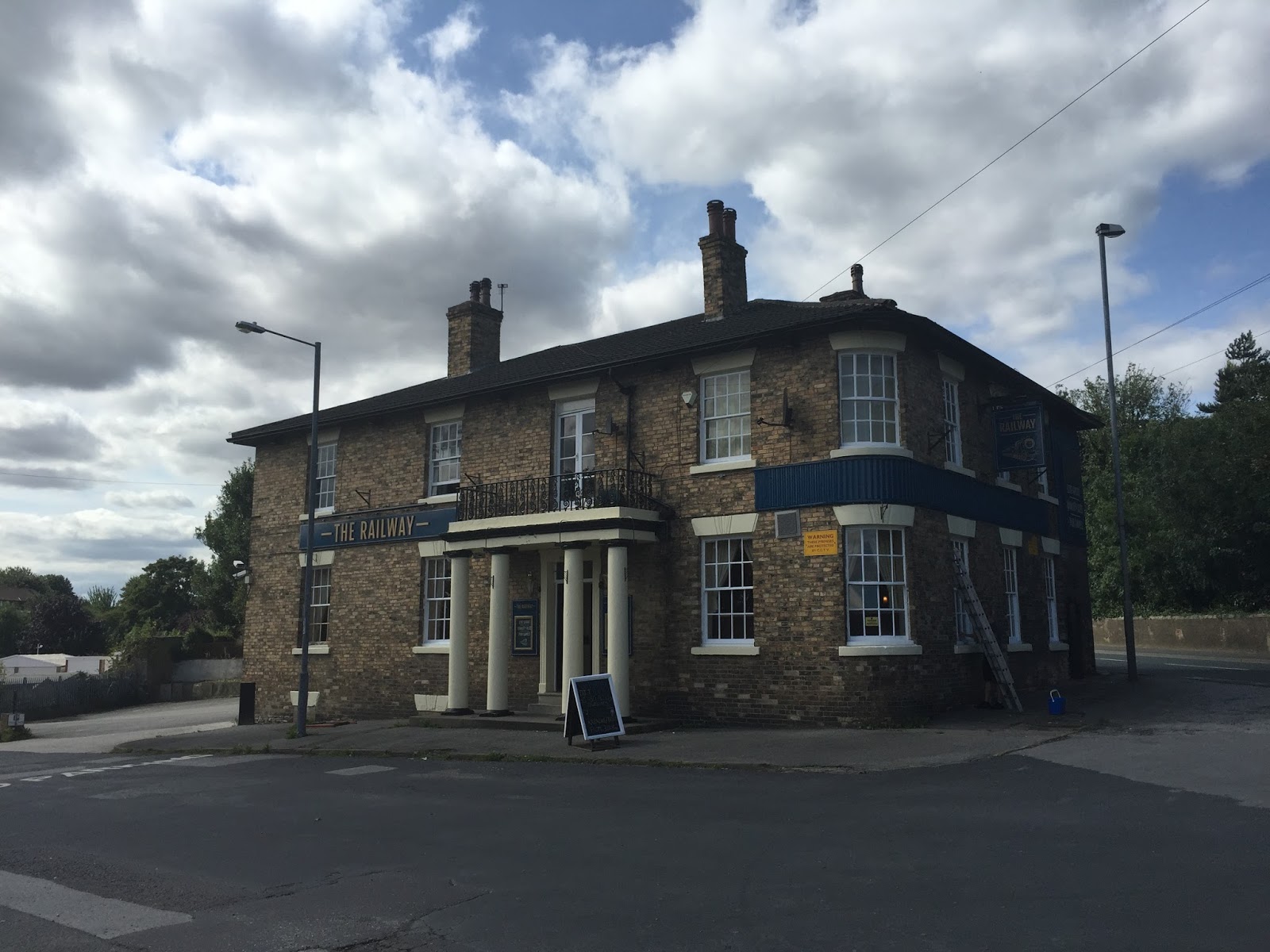
Outside the station was a builders yard, with a sign warning that cars caught parking in front of the entrance would be removed if necessary by fork lift truck, and then a stout pub.  Again I wondered how many pubs were called the Railway.  Must be in the hundreds.


The idyllic blue skies were beginning to be tinged with darkness as I took my sign picture.  I had two more stations to collect that day, but they only got services in the evening.  I had an afternoon of dozing in a Premier Inn to look forward to first.