Showing posts with label Cross-City Line. Show all posts

Thursday, 28 November 2024

White, Chocolate


This is entirely in my head, I know, but it seems to snow in Birmingham a lot.  Well, at least it seems to snow a lot when I visit.  I was last on this section of the Cross City line in March 2023, and it was snowing then.  I come back, and it snows the night before, and then again while I walk around.  Perhaps I'm simply used to endlessly mild weather, being a resident of The Leisure Peninsula itself, the Wirral; we hardly ever get snow.

I was here to close off the last remaining gap on the line, the four stations between Bournville and Longbridge.  This is, of course, the home of Cadbury's, purveyors of fine chocolate, and the local factory has contributed to its station by painting its metalwork Dairy Milk purple.


That's the beginning and end of its contributions, mind.  The rest of the station is the tin shed aesthetic common on the line.  I'd hoped there'd be a bit of extravagance here, perhaps a giant Caramel bunny or benches shaped like a Freddo, but the purple was all you got.  I headed down to the street and took my sign picture.


I was tucking my camera back in my pocket when a man in a car at the neighbouring lights called out.  It took me a few moments to process that he was talking to me, and so I'd not been paying attention.  If I don't expect chat, my brain is simply not listening for it; it has to go back and rewind and process it.  I said, "what?", because I am a master of witty repartee, but he didn't say anything more and drove off.  

My brain finally deciphered the words from the thick Brummie accent and I realised that he'd said "ain't you never seen snow before?"  This immediately put me in a bad mood.  I wasn't doing any harm.  I was amusing myself.  And this bloke decided to pop up and police it.  Reader, if you see someone doing something innocuous you disapprove of, keep it to yourself, or do what I do: bitch about it on social media where they can't see it.  Calling out to random people and judging their behaviour leaves them feeling angry and vulnerable and socially awkward, and I'm all those things normally anyway.  Don't add to them.


Cadbury's is directly opposite the station, and it's an intriguing mix of architectural styles.  There's this half-timbered Olde Worlde building, but right behind it is a high brick factory, while access roads give you glimpses of steaming vats and loading bays.  A more modern office block and reception desk has been squeezed onto the street.  It'll never be confused for Willy Wonka's place, let's put it that way.


Not that it's stopped them trying.  Cadbury World is at the back of the factory - annoyingly, quite a walk from the station - and was opened in 1990 as a visitor attraction with interactive displays and histories and a lot of opportunities to stuff your face.  


I would not be visiting Cadbury World on this visit.  For starters, I've already been, back in 2010 with my friends and their children.  You shouldn't really visit unless you have children present, because the exhibition is very much aimed towards them.  A single man wandering around that place would get some funny looks.


Secondly, I don't really like chocolate.  I'm not sweet toothed at all.  I'll occasionally get a craving, and I'll get a Dairy Milk or a Fruit and Nut, because Cadbury's is the best; I've tried those supposed luxury bars that are 60% cocoa beans or whatever and they all taste bitter and unpleasant.  Otherwise, I can do without it.  In fact, once on holiday in Yorkshire, we visited an artisan chocolate making factory, and I had to go outside because the sugary sweet smell was making me feel ill.  I'd much rather have a packet of crisps or a pasty.  (The BF is the exact opposite, and he was extremely disappointed when I came home from my trip without a sack of Roses for him).  


I was far more interested in visiting Bournville itself, the model village built by the Cadbury family around the factory.  It was constructed as an ideal place for working class people to live - all working class people, not just workers at Cadbury's.  George Cadbury was a Quaker and it was his intention to create a community that was airy and well-maintained and with good architecture.  It was a contrast to the small homes and squalid conditions most employees could expect at that time.


In addition to hundreds of houses, community facilities, parks, churches and shops were built - but, as a teetotaller, George refused to allow a pub to be built.  Bastard.


Bournville's homes were far grander than those in Port Sunlight, its Scouse model village cousin.  I got the feeling that the Levers spent their money on the art gallery at its centre and the houses were not a priority.  Port Sunlight's gardens are largely communal, and the houses are more cottagey than the proper semis and detached homes here.


If it had been a nicer day, I'd have happily wandered around Bournville for hours.  Unfortunately the snow was really coming down now, leaving me cold and wet, so I did a loose circuit then headed back to the main road to continue south to my next station.


The village has become an incredibly desirable place to live in the century since it was built, and this has extended to the areas around it with a similar postcode.  If you can't afford Bournville proper, then the terraced homes nearby will give you that same frisson of middle class glamour.  It's why a flat row of shops, a strip that I'd seen all over the country that would normally house a corner shop, a couple of takeaways and a hairdresser, instead included a Zero Waste supermarket and "Birmingham's first organic butcher".


Linden Road went up and down over the hills, sliding down the social scale as it did.  They'd tried to make the council houses vaguely in keeping with the model village, but it was done on a budget, with none of the Arts and Crafts styling or elaboration.  It's a shame that uber-capitalist George Cadbury's hopes for the average person's home were undone by capitalism itself, firstly by restricting the money spent on public homes, then by selling them off and putting them out of reach of your working man.  Nothing like Bournville is being built today, and if it was, it certainly wouldn't be affordable for someone who worked in a factory.


Kings Norton was a messy stretch of shops spread around a junction.  Buses idled at the side of the road.  People inched their way along the pavements, remarkably clear in the main, but with the threat that the stuff falling would settle.  Chicken shops and pound stores and the Kurry Kingdom in an extremely impressive building.  I hummed Heather Small as I walked past Pride Dry Cleaners and avoided the queues of people getting their lunch from Sophie's Pizza and Pasta.


The bus layby came with another of Centro's pieces of art, a pair of metal feathers on top of the transport information board, but unlike many of the other ones I'd encountered during my visits to the West Midlands, this one still had its information board, telling me about the work and the artist.  I'm not sure if that's because of a commitment to informing the public or more likely nobody's got round to taking the poster down.


It means I can tell you these are the Feathers of Freedom and were designed by Paula Woof in 2001; they are made from stainless steel and represent "the sense of freedom felt by generations who moved here from central Birmingham".  So now you know.


Kings Norton (the apostrophe seems to be an optional extra) is about to get a lot more important.  The Camp Hill Line once carried trains direct into Curzon Street, but, starting with the replacement of that terminus with New Street and continuing through the improvement of other lines that shadowed it, it slowly fell out of use before closing to passengers in 1946.  It continued as a freight line but that was it.


It's now, excitingly, rarely, significantly, being brought back into passenger use, albeit incredibly slowly.  Three new stations have been constructed along the line and, eventually, trains will split off at Kings Heath for the city centre, making this an interchange station.  Fortunately it's already got four platforms to accommodate the two lines.


I mean, that's the theory.  As is usual for British infrastructure, it's both hopelessly late - it should be open right now but they're still working on the stations - and also done on the cheap.  Those extra platforms are going to remain out of use, because the money isn't there, just as the money isn't there to build a viaduct at the other end to get Camp Hill trains into Moor Street (where there is capacity) instead of New Street (where there is not).  These will, presumably, be completed at a later date, when all the engineers have gone home and the planning permission has lapsed and they'll have to start all over again from scratch.  Clever.


I got off the train at Northfield behind a man with an enormous snuffling pit bull, running from side to side all over the platform and clearly not enjoying that the snow hadn't been cleared.  His stomach dragged through the piles and he hopped pathetically to try and avoid it (the dog, not the man).  The snowy platform added to a feeling that Northfields was a little unloved and deserted, a feeling not helped by a local network map on the wall being so old it still showed the Metro terminating at Snow Hill (a stop closed in 2015).


I followed two Eastern European ladies down the steps from the platform, listening to them chat merrily to one another, then passed through the subway under the tracks to the other side.  There was another piece of Centro art and, once again, there was an information piece for it, confirming my suspicion that these are only still there when someone at TfWM forgets to take them down.


This one is the All Seasons Tree by Rosemary Terry.  Erected in 2003, it's intended to represent the network's dedication to providing a service in all weathers - especially appropriate on a day like today, where the snow had given it a festive dusting.


I walked down the hill from the station entrance, past a garage advertising £40 MOTs and onto a side road.  The snow had stopped falling and the thaw had started, leading to a great river of water cascading down the drains.  I stepped into a patch of open land, breaking the snow with my feet, and following a short path into a copse of woods.


The drips of the melting snow were everywhere around me, accompanied by the rustle of bushes as lumps fell to the ground.  One or two pieces careened off my forehead, and I briefly considered the humiliation of being discovered unconscious in a wood having been accosted by frozen water.  I'd have to lie and pretend I was mugged.


I decided I'd swing back to the main road, rather than persist on my country walk.  The River Rea crosses The Mill Walk as a ford here, something you don't really expect to see in suburban Birmingham.


Immediately after I took this photo, a BMW appeared and crawled through the ford.  The driver then burned away at a ridiculous speed, his engine roaring, in case you thought that his slowness through the water indicated some sort of reserve or timidity and you didn't realise that he was actually an extremely masculine man who was manly.  Needless to say, I was extremely aroused, and definitely didn't assume he had a micropenis.


The main road was a wide straight boulevard with space for trams in the middle if they ever decided to restore them - which of course they won't - and plenty of shops.  On the corner was a JobCentre, which was pretty essential, as I was now entering Longbridge.


If you're of a certain age, the name "Longbridge" brings back memories of news reports, first about strike action, then about decline and closure.  This was the home of the Austin Motor Company, later British Leyland, later Rover, the builders of dozens of legendary British cars and a hotbed for complex industrial relations for over a century.  The factory took up a huge expanse of land and employed thousands of workers locally, before slowly declining over the second half of the twentieth century for a million different, equally sad, reasons.  The plant shrank and contracted until its very last stub - making MG cars for its now Chinese owner - was closed in 2016.


This leaves the question of how to regenerate the fallen area.  Housing has been a key part of it, of course, with flats and houses filling the former assembly areas.  The people who live there need jobs though and so a new Longbridge town centre has been constructed.


It's heralded by the South & City College Birmingham, housed in a truly hideous building that strives for "iconic" but actually ends up as "messy".  Architects and city planners have looked at the likes of the Bilbao Guggenheim and their takeaway seems to be "weird angles, gotcha".  They've avoided building square boxes and have instead embraced lumps, shards, spikes, all layered with coloured cladding.  They are, almost without exception, hideous, and will be demolished in about twenty years time when they stop being fashionable because nobody will want to refurbish them.  


Beyond it is open space, a series of terraces and flower beds beside the River Rea that form Austin Park.  There's also Austin Way, Cooper Avenue and Princess Street, all named after the former marques, which seems off to me.  Imagine being a former engineer at the plant, spending decades crafting those vehicles, and now having to trudge down Ambassador Avenue to get to your job fetching trollies in Sainsbury's car park.  That's rubbing salt in the wounds.


Because Longbridge has now been reborn as a shopping centre.  The signs might pretend it's a civic heart, but make no mistake; this is an out of town retail park that has been allowed to bloom here.  It was surprising to me how bad it was.  We've learned over the past few decades that making a place is the future of retail, that now we can get anything we want delivered to our homes, we have to encourage people to venture out.  


This is an L of boxes arranged around an open-air car park.  You could've put in a pedestrian square here, a space for exhibitions or events, or arranged the shops into more interesting avenues to be explored and enjoyed.  You can hear the developer grumbling: "we gave you that park, isn't that enough?"  It shows how big business can take advantage of down on their luck areas.  With the closure of the car plant, no doubt Birmingham was simply happy anyone wanted to build anything that would provide jobs, and waved it all through.  


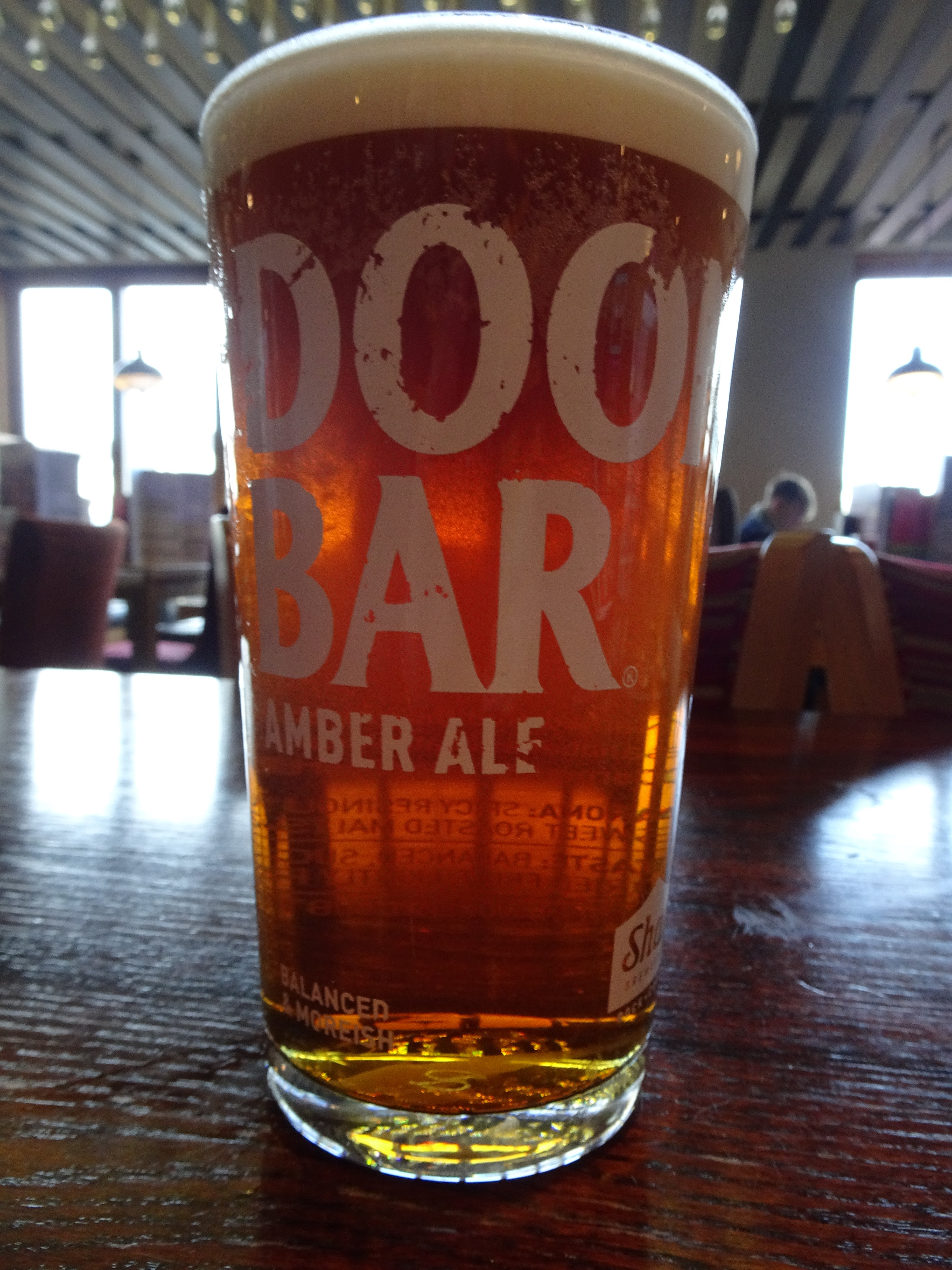
It was lunchtime and I had time to kill before my pre-booked train home so I decided to sample the delights of a Hungry Horse.  I don't think I'd ever been to one before, but it wasn't exactly a surprise; sub-Wetherspoons decor, blandly unthreatening, plenty of seats and a reliance on food rather than the odd old bloke nursing a half of bitter.  It was a Tuesday, which meant the special was a "sizzler" for nine pounds.  This meant I got a skillet of vegetables with some breaded chicken, some onion rings and some chips, plus a mysterious powder that was supposedly a salt and pepper herb mix.  It was, technically food, but only technically, because food usually also has flavour and texture.  This was more like eating polystyrene that had sat next to an air freshener and had picked up a bit of the scent.  However, after several hours of walking in snow and getting soaked and frozen I was simply glad to get something hot inside me.


Also, they served beer.


I tottered out an hour later with a couple of pints sloshing around and wandered towards the railway station.  TfWM have constructed an enormous multi-storey next to it, with the hope of making Longbridge a park and ride.  As you'd expect for an area formerly filled with factories, there's a good road direct to the M5 from here, and the hope is that this will become a hub.  Network Rail, too, want to make Longbridge into a secondary rail centre, getting people to change services away from the overcrowded city centre termini.  As usual, there are lots of lovely reports, and not much in the way of action.


Longbridge has, at least, got a flashy new building out of the redevelopment, with a completely pointless architectural flourish over the roof, which was probably called a "placemaker" or something in the plans.  


The Centro artwork is, unsurprisingly, themed around the former factory, and is called The Genie of Industry by John McKenna.  It's a stark robot in an area that's increasingly softened.  I couldn't help thinking it would've looked far more part of the landscape when it was unveiled in 2002.


As I took the picture of the statue, a man lurched out of the bus stop and towards me, clutching a bottle of Stella.  Obviously I disapproved; one should confine one's alcoholism to inside spaces.  Like me.  I moved away quickly, down to the platform, and was able to almost immediately jump on a train.


Then I began to get a niggle at the back of my head, a light tap of disquiet.  Something was up.  I picked up my camera and scanned through the pictures and - yep.  I'd not taken the sign selfie.  

This is becoming disturbing.  My brain is starting to forget to do the one thing I have always done when I visit stations.  I've been doing this for nearly eighteen years.  Is this how dementia starts?  I got off the train at Northfield and transferred to the southbound platform to go back on myself.  This meant that, sadly, I wasn't able to visit the refurbished University station as I'd planned; two long waits for trains put me dangerously close to my train time from New Street and my anxiety was raging.  I'll have to check it out another day.


Still, I'm sure you'll agree the trip back was totally worth it for this magnificent photograph.

Don't answer that.

Wednesday, 6 April 2022

Best Laid Plans

There are some days when you just shouldn't leave the house.

I had everything planned.  I spent an afternoon working out how to visit three stations on the West Midlands Railway map: Tamworth, Willington and Wilnecote.  The last two get only a couple of CrossCountry services a day, so the timings had to be precise to be able to collect them.  I worked out a way of doing it that meant I would finish my day with a train from Willington to Birmingham at 17:17, getting into New Street at 17:55 and allowing me to dash to get the Liverpool train home at 18:04.  It was a tight connection but I thought it was perfectly do-able, so long as I could make it across the station in time, and I thought I'd got the geography of New Street sorted enough to be able to manage it.

I bought all my tickets and loaded them into the CrossCountry app.  Another e-mail came with the confirmation, warning:

Due to the continued issue with train crew availabity... there will be disruption from Saturday 26 March - Friday 1 April.  We will be running a normal timetable, but there may be some short notice cancellations and fewer carriages...

I could live with that.  It was a risk but fair enough.  The morning of my trip out, I went to the CrossCountry website to check that my trains were still running.  I was surprised to learn that my 17:17 train no longer existed.  Instead, there was a train twenty minutes later.  Those of you paying attention will realise that meant I would miss my London Northwestern train home.

I sighed and went into the customer chat and they confirmed, yes, the timetables had changed, but don't worry: your ticket is still valid.  Well, your CrossCountry one is.  I was stuffed with the London Northwestern one and because it was an advance ticket, there was no refund.  Because I like to be sure I can get home - I'm funny like that - I went into the LNW app and bought a ticket for the next train after the one I should've got.  Then I headed to Lime Street for my day out.

(Don't worry, I'll stop complaining in a bit.  Bear with.)

I had nearly an hour to kill at New Street before my train to Wilnecote so I wandered up into the shopping mall to have a poke round Foyles.  I bought a couple of books, thanked the Lord there wasn't a Foyles in Liverpool or I'd have no money left, and went back down to see if they'd got a platform yet for my train.

The word Cancelled lit up on the departure board.  I rushed to Twitter.


A major trackside fire was taking place at Burton-On-Trent, meaning a lot of trains couldn't run... mainly services through Tamworth, Willington and Wilnecote.  Those of you still paying attention will notice that those are the exact stations I'd been planning on visiting.

Bugger.

That was the end of that, I thought.  Even if I hung around the station in the hope that services would come back, they would be chaotic for the rest of the day.  Those very specific trains to very specific stations would be out of the question.  I was, in short, stuffed.

After a few minutes of despondency - nobody likes to go to New Street unless they really need to - I decided I'd have to go somewhere.  I bought a Daytripper ticket from the machine, scanned the departure board, and rushed down to a platform to get a train.  I was going to Chester Road!


If you're the kind of person who comes to this blog in search of meticulously-researched facts about places, then first of all, aim higher, because I am no diamondgeezer.  A bit of cursory reading and that's it for me.  Secondly, you're not going to get any of that in this blog post.  I was travelling blind.  I picked the Lichfield part of the Cross City Line purely because I knew for certain I'd not visited any of the stations there; if there were exciting, unique sights for me to see, I had no idea.  If there's a flock of wandering ostriches housed in a field round the corner from Chester Road station, I missed it, and I'm sorry.


I will say that I got into station collection mainly because I like station architecture.  Not only historic, Victorian, birth of the railway stuff, but also the styles beyond - the Art Deco, the Brutalist, the Post-Modern.  The West Midlands haven't been great for any of that, if I'm honest, because a combination of extreme British Rail cutbacks, electrification and a general malaise about history means a lot of the station buildings have been swept away.  Having said that, I think Chester Road deserves better than a tin shed for its platform buildings.  Not even a shed, actually; a shed has four walls and a roof.  This is a curve of ugly steel, a bus shelter somehow extended to fifteen metres, and it's determinedly cheap and utilitarian.  You're covered from the rain and that's it.


One sign snap and I was off down a side road, shadowing the railway north to the next station.  There were a few rows of railway cottages, with small terraces beyond.  In a very Birmingham vista, a block of flats peered over the top of the older buildings; no matter where you go in England's second city, there always seems to be a high rise hovering in the background.


There was a primary school, the kids loudly raucous in the playground, boisterous and joyous.  The houses turned to Arts and Crafts semi-detached homes, early suburbia, each pair slightly different to its neighbour to make you feel unique.  A lot of them retained their front gardens, which was increasingly rare in a world of two or more car houses, and bare trees occupied verges at the road's edge.  


Google Maps had suggested that I should stick to the road I was on, but there was a signpost, and I'm easily swayed so I followed that for my next station.  It took me onto The Boulevard, a road - no, an avenue - of subtly moneyed homes.  It was sitcom land, Terry and June, cooking dinner for Sir, with the cars still on the drive because the owners had walked to the station for their city centre job; Reggie Perrin with a Brummie accent.  Every fourth house had a builder doing improvement works.  Every third had a loft conversion.  I followed a man who came out of a house with a wheelbarrow.  At first I thought he was a gardener, but then he took a swing onto a side access route, and I realised he was headed for some allotments.  The West Midlands' answer to Tom Good.  


The skies were turning.  I'd left home with my jacket stuffed into my bag - it had been warm and pleasant back in Liverpool.  Here there was a chill and a greyness that threatened worse to come.  The winds whipped up, whirling round me.  I reached the top of the Boulevard and paused to take a picture of the charming green space.


Before I could put my camera away, the snow started.  A little, then a little more, then a lot.  


I hovered behind a hedge and wrestled with my bag, pulling my jacket out.  By the time it was on and I could proceed the odd flakes had become a flurry.


Time between those three photos: less than two minutes.  The snow wasn't settling, and I knew it would just be a shower, but it was still a shock to see how swiftly the weather had turned.  Only a couple of days before I'd been wearing shorts and a t-shirt and now it was winter again.

On Station Road, the wind smacked me in the face, barrelling along the tarmac and catching at my loose coat.  (I will only button my coat in the direst of blizzards - don't ask my why, I've always been that way).  Fortunately my next station was visible, marked out with a huge sign across the road bridge, making it easy to pose and look like I had dandruff.


By the time I reached the platform at Wylde Green the snow had slowed to the odd flake.  I took up a seat for my twenty minute wait for the next train.

The wait did allow me to experience one of the pleasures of the Cross City line.  They have one of the best sounding trains on the network, the Class 323s, which whirr and purr as they take off.  As someone who doesn't particularly get excited about trains, I have to say, the 323s are a definite favourite:


I had to check what class of trains ran on the Cross City Line on Wikipedia by the way, and that's where I learned that they're about to be replaced by the Class 730s.  Whether these trains have a distinctive burr, I am yet to discover, but I bet it's on its way out.


By the time I'd finished the sandwich I bought at Lime Street (Marks and Spencer Ham and Coleslaw, hadn't spotted it had coleslaw in it when I bought it, 4/10), the skies were blue again.


I boarded my train, leaving wet footsteps behind me, and took it the one stop to Sutton Coldfield.  Sorry, I should rephrase that: I took it the one stop to the Royal Town of Sutton Coldfield, whose platform signs feature what apparently passes for an Attractive Local Feature board in the West Midlands.


Really makes you want to rush to Sutton Park, doesn't it?  


I'm being overly harsh.  As it turned out, Sutton Coldfield still had its original Victorian station building, though a little bit of reading tells me that this was only thanks to vigorous local campaigning in the 1970s.  Entering the fine booking hall with its high ceilings and benches for people to rest, you have to wonder about the mentality of an organisation that would willingly wipe this away for nothing more than "progress".  Is it the most beautiful railway station you've ever seen?  No.  Does it work?  Absolutely.


Outside, the station sign persisted with the Royal Town of Sutton Coldfield moniker, even though the map and the National Rail booking system insisted otherwise.  A bit of reading up - and as I say, I'm not IanVisits - shows that it gained this title when Henry VIII granted it a charter.  When it was incorporated into the city of Birmingham for local government purposes in the Seventies, it seemingly lost its status, but thanks to campaigning from the local MP Andrew Mitchell it was confirmed that Sutton Coldfield was still entitled to use the term.


There are a few pertinent facts to be dealt with here.  The first one is that Andrew Mitchell is awful, but he's a Tory MP so you knew that already.  Secondly, having Henry VIII give you something in the sixteenth century isn't a card you can wave for another five hundred years.  Peter Chardstock said I had a cute arse in 1995 but that doesn't entitle me to claim I have a cute arse until the end of time; things change, and since there's not a Royal palace or a castle or even a small flat where Andrew carries out his improper business in the Sutton Coldfield area, clinging onto that title seems a bit daft.  You're not Windsor.  Thirdly, and this is the most important point, who on earth gives even the tiniest of shits?


I headed into the town centre, which is absolutely what you expect from a West Midlands town centre, i.e. a precinct.  As with all smaller town centres in Britain, it was experiencing a real downturn, with vacant units outnumbering the occupied on the pedestrianised street.  There was a Taco Bell, which always gives me a start.  There's been a Taco Bell in Liverpool for years now but it still doesn't seem right.  Taco Bell is such an American place, far more than Pizza Hut or McDonalds, and seeing it on a boring old UK high street is a weird clash of cultures.  It's like a giant Twinkie sitting on Nelson's Column.


At the bottom of the street, there was a "restaurant quarter" i.e. a Nando's and an Ask Italian, but I followed the ring road back round, ducking through the Aldi car park and finding myself on a side street outside the Market Hall.  It had rebranded itself as the place "for life's essentials", but then the sign listed "life's essentials" as "shoe accessories, evening purses, slippers, trolleys, belts" so I suppose the people of Sutton Coldfield have different priorities to me.


Past an office block built to look like a Georgian terrace and a multi-storey car park that looked very closed indeed and I found myself back at the foot of Station Street.  I turned up into Mill Road, where I discovered the historic heart of Sutton Coldfield, the part they would probably put on postcards if municipal post cards were still a thing.  (Are they still a thing?  I hope so).  


The steep hill past the Masonic Hall - a building I noted the ring road avoided demolishing, funnily enough - came out on a civic crossroads with old buildings and the parish church.  No, the clock in the clock tower didn't show the right time, which was a shame, but it was a nice little district.  There were tiny shops here who obviously thrived on being different to the mainstream stores in the precinct, though sadly quite a few of the fronts were vacant.  Quirkiness alone can't carry you through a pandemic.


The pavement was filled with schoolkids, teenagers from the Grammar School and the College that lined the road.  Many of them had that distinctive arrogance that A-level students get because they're allowed out of class outside of normal times.  It's a "yeah, the KIDS can only come out of the school building during the lunch hour, but it's gone two o'clock and I'm off into town for a burger, I ROCK" attitude that I know all too well from hanging out in the Arndale of an afternoon while I was in Sixth Form.  There was also an impressive civic complex for the police and fire service, built at a time when local government pomp was encouraged, though the former magistrate's court in the centre is now the Sutton Coldfield Masjid.  Bet the policemen loved that moving in next door.


Beyond that, there were mansion houses - converted into flats of course - punctuated by blocks of a more modern vintage.  The Holy Trinity Catholic Church loomed over the street, impressive and imposing, a model of 1930s modernity.  That was a boom time for churchbuilding in the UK as they rushed to fill the new districts with parish buildings, a move that carried on right up until the 1960s.  It's a shame in a way that this peak of construction was immediately followed by a rise in atheism that meant they lost a huge proportion of their visitors.  Holy Trinity continues, but I noticed from its website that it has combined with other churches to form a parish now.  


There was a sign pointing to The Belfry, the Open-hosting golf club that even I've heard of, and then a crossroads where the A5127 meets the A453.  It was controlled by a set of traffic lights but there were no pedestrian crossings there.  This drives me absolutely crazy - you're installing a set of lights anyway, stick in a pelican crossing so that people don't have to dart across lanes of traffic.  It'll delay the drivers by a minute at most.  Whatever you've saved by not implementing a pedestrian crossing is cancelled out by the cost of constantly having to clean blood off the road.


I made it across in one piece and pushed on past the gated houses and apartments.  At Bracebridge Road, there were signs indicating that this was the Four Oaks Estate and a private road.  No Through Road - Residents Only they snootily declared, and if I'd known about this place beforehand I'd have immediately turned down there to have a poke around.  It's apparently one of the most exclusive estates in the County, with million pound houses, and last year they applied for planning permission to erect gates over the roads to seal them off.  It was rejected by the planning committee - unanimously, I should add, at 10-0 - on the grounds that they are privately maintained public highways and a right of way.  Well done Birmingham City Council, stick it to the poshos.


The road split further up around the Four Oaks methodist church, so I took the right hand fork.  The station was there, but I pressed on.  I'd been walking for a few hours, so I thought I deserved a treat, and headed into the commercial district at Mere Green.  It quickly became clear why Sutton Coldfield town centre wasn't in a great way - the people with money didn't shop there.  Mere Green was a strip of beauty parlours, dog grooming establishments, and restaurants.  One restaurant promised Filthy burgers and Kick Ass Chick'n; you can always tell when an area's posh because they love to serve more disgusting and calorie filled versions of the food they sneer at working class people for eating.  There was an M&S Food Hall and a Sainsburys, plus a small pedestrianised shopping complex (definitely not a precinct, how dare you).  


There was also a Cook shop, which turned out to not be a cookshop, but instead a store solely devoted to those astonishingly expensive ready meals they sell in garden centres that look quite nice but not worth the money.  (£7.95 for a lasagne for two?  Nah, you're alright, thanks).  I didn't even know they had branches, and I realised why: their only store near Liverpool and Manchester is in Hale, and you can only enter Hale if you own at least three gold cards and have caps on all your teeth.


I found a pub and took a seat.  I'd at least relaxed after the stresses of my best laid plans going to pot.  Even though I've been travelling all over the country for years by rail, I still get extreme levels of anxiety every time the trains go wrong.  It doesn't suit my brain.  If I've planned something, I need it to go right.  I checked Twitter and CrossCountry were tentatively hoping to start their services back through Tamworth at three o'clock-ish, meaning I may have possibly been able to visit Willington after all.  That was no good to me over here in Sutton Coldfield, of course.  Another day.


One pint became two, became three.  Lightly toasted, I left the pub and made my way back down the road to Four Oaks station.  This is the limit for some of the trains from Birmingham - the rest continue on to Lichfield Trent Valley.  I thought about going north again, maybe collecting the last two stations covered by my Daytripper ticket at Butlers Lane and Blake Street.  But the beer was swilling around inside me, and there was a southbound train on the platform ready to depart.


Soon I was riding the whizzy, whirry 323 back into the city centre, happy and contented.  It may not have been the stations I'd expected to collect, but an afternoon out on the trains is never a bad thing.

    
***********

The beers on this trip were paid for by Kevin's very generous donation over on my Ko-fi.  Thanks again, Kevin!