Thursday, 9 July 2015

Hat-Trick


With a Sainsburys' New Yorker sandwich inside me (Pastrami and gherkins; luckily I wasn't on the pull) I disembarked the train at Burley Park.  I'd done four stations that morning; this afternoon I hoped to polish off another three.


The passengers at Burley Park were very different to those I'd encountered in Cross Gates and Garforth.  Now they were a mix of Asian families and students, the latter slouching their way down the road with backpacks dangling heavily around their waist.  I turned a corner and found a fabric shop with its window display filled with brightly coloured saris.


I accept that working for the council can be a bit dull.  Been there, done that.  But I feel the planning department at Leeds City Council may have taken their eyes off the ball when it came to laying out the area round Burley Park station.  I was walking along Beechwood Crescent, past a series of smaller streets that ran up to the railway line, and the road signs were a parade of "will this do?".  Beechwood Grove.  Beechwood Street.  Beechwood Row.  Beechwood Terrace.  Beechwood Mount.  Things briefly got interesting when Graham View appeared, until that was followed by Graham Terrace, Graham Street and Graham Grove.  I guessed that this district was laid out by a town planner just before the Christmas lunch - a town planner who was probably called Graham Beechwood - and he'd already had a couple of sherries before eleven.  "Fourteen streets named in two minutes - sorted.  Now where's that turkey!"


A cut across the railway via a narrow bridge, then I found myself at the foot of Headingley stadium.  One of the Headingley stadiums, anyway.  Much like Old Trafford is for Manchester, Headingley is for Leeds: a concentrated hit of sporting action, with two grounds right next to one another.


Headingley is home to both Leeds' Rugby League team, the Rhinos, and its Union team, the Yorkshire Carnegies.  I have no idea what the difference is between Rugby League and Rugby Union.  The second one is more popular with public schoolboys down south, I know that; League is more popular with gruff Northern types, so I suppose it involves more fighting.  I did do rugby at school, for one year, and mostly what I remember is it was really cold and you weren't allowed to throw the ball forward, only backwards.  Is that League or Union?

Oh, let's be honest, I don't care.  My interest in rugby begins and ends with Ben Cohen, Scott Quinnell and the chaps at the Dieux du Stade.  If they want to play with oddly shaped balls as well, fine, whatever keeps them happy; just make sure you keep releasing homoerotic calendars featuring all the players in tiny pants (or less).


A grim alleyway ran behind the stadia, and I used it to cut through to the cricket ground.  Now cricket I have even less time for than rugby.  Cricket is one of the most boring, and at the same time, most ridiculously complicated ways to spend a week (a week!  A match takes a week!).  I have absolutely no idea how cricket works.  You have to throw the ball to knock the stumps off; that bit I get, but the scoring system is incomprehensible to me.  The BF has used this against me on numerous occasions; he'll be watching some interminable cricketing farrago, and I'll say "is there much more of this left?"

"Just four overs," he'll reply, which doesn't sound like much, but it turns out an over is roughly equivalent to eight months, and I never get a look in on the telly.


I may have got the cricketing terms wrong there, but the important fact to remember is, I don't care.  I understand the appeal of many sports on an intellectual level, even if I don't particularly like them myself: they're exciting, they're full of drama, they keep you fit.  Cricket does none of these and yet people still pay good money to watch it.  It baffles me.  They don't even produce any decent looking sporting hunks, with the possible exception of Freddie Flintoff, and even he's a bit of a cock.


About the only thing cricket has going for it is their remarkably experimental attitude to architecture.  Lords has its amazing lozenge shaped media centre, while the Oval has the elegant curve of the OCS stand.  Headingley has the funky green and white Carnegie Pavillion, which also includes teaching facilities for the sports faculty of Leeds Metropolitan University.  It also has these floodlights, which I thought were just designed to be interesting until I looked at the photos and realised they were the White Rose of Yorkshire.


Cricket attracts a very different class of neighbour to, say, football.  While the streets around Anfield and Goodison are narrow terraces for the working man, Headingley was set amongst large detached homes surrounded by trees.  I walked along a busy but pleasant road beneath oaks and sycamores, shielded from the sun by their tall branches.


It was only once I crossed the railway line again that the trees disappeared.  There were tower blocks now, and a greasy spoon called Sunny Side Up, and an old woman enjoying the sun in her front yard wearing fewer clothes than you'd expect from a lady of her age.


The station here is called Headingley, though it's probably further away from the stadiums than Burley Park; I expect the locals know which station to alight at.


As you'd expect from a station that was so important to the leisure of the Victorian gentleman, it has an impressive station building.  As you'd also expect from a Northern station in the 21st century, the building is no longer used for railway business, and instead has been taken over by Sensory Leeds, a charity for disabled people.  It's great that the building is still in use, and for such a fine purpose too, but I'd quite like there to have been just a tiny ticket office somewhere in there.


There was a footpath running under the tracks, and to cross it, there was a pedestrian bridge.  Signs warned me that it was "weak", making me anxious as I stomped across the wooden boards.  Do they really force all those cricket fans to pass over this?  Isn't that incredibly dangerous?


Headingley station was disappointingly ordinary.  I thought it might have a bit of a sporting theme going on, like the wonderful Oval station on the Underground; perhaps cricket tableau on one platform, and rugby themed ones on the other.


Nothing.  Not a mural, not a painting, not even a bog-standard ALF.  There was a tiny poster marked How to get to the Headingley Carnegie Stadium but that was just a map.  Could they not get the Yorkshire Cricket Club to adopt the station?  Make it into a bit more of a destination, a bit of an attraction in its own right?


My final station of the day was Horsforth, the last station in West Yorkshire on the Leeds-York line.  I'd already done the rest of the stations on this route so this was something of a momentous occasion for me.


Luckily, Horsforth was lovely.  It was busy and well-used; it had plenty of facilities - including an actual ticket office with an actual person in it - and to leave the northbound train you had to cross a footbridge over the Old Mill Beck.
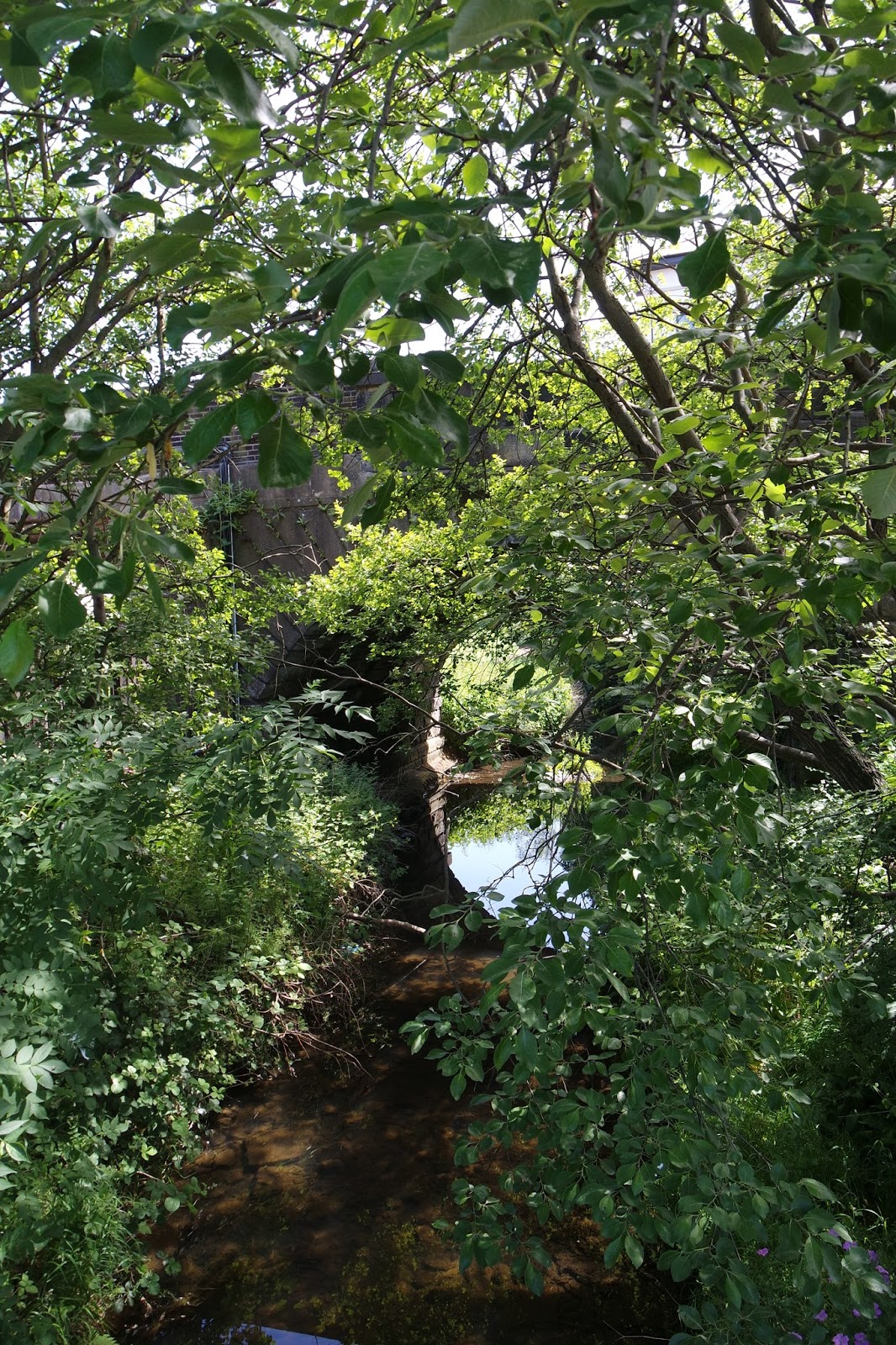

Leeds Trinity University is based in Horsforth, a former Catholic teacher training college which only gained degree awarding powers in 2012.  They still seems to be vaguely excited about being a university town, with plenty of signposts to guide you to the facilities and a church carrying a banner saying "We welcome students" (don't we all dear).  The novelty will soon wear off, and next thing you know the local paper will be full of complaints about youths vomiting in people's front yards and making too much noise when the pubs close.


The High Street was lined with cafes and delis, their outdoor tables well patronised on this sunny day, and terminated at a large roundabout.  Crowning it was The Old Ball, a pub-slash-pizza kitchen.  I immediately regretted that naff sandwich (I am a whore for pizza of any kind).  I was going to venture in for a pint, but the tables outside were covered with laughing, happy young people and slightly overdressed women who'd clearly arrived here in open topped cars.  They all looked so charming and nice and popular that I immediately felt inadequate.  I turned away, and headed for the much smaller Fox and Hounds.


The barman at the Fox and Hounds was about eight hundred years old; when I went into the beer garden - more of a terrace at the back - there were only two other tables occupied, and both of those emptied before I was even halfway through my pint.


I leaned into the plastic chair - it creaked ominously - and thought, yep, this is more my style of pub.  Not the sexy one with the gourmet meals and the effervescent clientele.  The empty one that everyone ignores that's past its best.

I may have self-esteem issues.


Wednesday, 8 July 2015

Pit Stops


I like Leeds.  It's a proper, well-built, historic city.  It feels lively, it feels thrilling.  It has that ever pounding pulse that all the best places have.

Having said that, it's not so good when it comes to more modern buildings.  Bridgewater Place, the tallest building in the city, is horrific: a lumpy mess that unfortunately towers over everything else.  The area around the river is lined with interesting warehouses and the blandest developments you've ever seen.


Then there's Quarry Hill.  For much of the 20th century, this was home to Quarry Hill flats, a giant circular piece of landmark social housing, modeled after the successful European designs.  When it was constructed in the 1930s it was astonishingly modern and progressive.  It wasn't maintained though, and like Sheffield's Park Hill flats, it became notorious, before being demolished in the late 1970s.


Surrounded by dual carriageways, Quarry Hill is now a sort of cultural island on the edge of the city centre.  The West Yorkshire Playhouse, the BBC, the Northern Ballet have all relocated to the site.  They don't feel like a part of Leeds though.  They feel like they've been parachuted in to bring some culture to the citizens, but they don't want to get too close in case they catch something.  Cultural districts need to be lively and vibrant.  There were too many service entrances and car parking spaces and dead ends.


The most heinous edifice on the island is Quarry House, home of the Department of Health and a grim Stalinesque lump.  It's like Terry Farrell's MI6 building, only more oppressive and frightening.  There is zero engagement with the street below, and the trees in front don't soften it; they just look scared.


I happily turned my back on Quarry House's gaudy ugliness and instead headed onto the busy throughway of York Road.  Just a little further on, it turned into a motorway, but here it was just an astonishingly large and traffic-filled road.


I was heading out to Cross Gates, a station in the suburbs.  This was actually my third attempt at collecting this station.  The first time, in January, was torpedoed by my own stupidity.  I booked the tickets for one day, but put it in my calendar as the next day; fortunately I realised my mistake before I got to Lime Street (I got as far as Conway Park).  So that was a nice waste of money.

The second time, in spring, I was ill, and couldn't even leave my bed.  I was starting to wonder if there was some kind of gypsy curse stopping me from ever getting there.  As I walked along York Road, I was half expecting a juggernaut to suddenly plough into me, crushing me up against the buildings behind in a Final Destination-type scenario.


There were hefty blocks of flats either side of the road, social housing highlighted in primary colours. An Irish centre advertised music from Paul Weller (in small letters: Tribute) and Sunday carveries.  A red and white striped former cinema, now a Thai boxing academy.  Wynsors World of Shoes advertised "we stock wellies all year round!"  Presumably it was an attempt to collect the festival market, but on a bone dry day with the sun scorching my face, it seemed sarcastic.


I managed to avoid being run over by a man in a mobility scooter.  I'm all for extending accessibility to the disabled, but really, they need to take note that pavements are mainly for pedestrians.  The path had narrowed into a narrow strip between the road and a row of red brick shops.  They'd been built long before the road, and now they found themselves staring out at a never-ending stream of unstopping traffic.  They were home to ethnic grocers, cafes, an off-licence.


The next road junction was ludicrously over engineered, with flyovers and flyunders and deep cuttings.  The houses around it looked nervous, as though they were trying to work out how they ended up on a motorway.  Pedestrians were herded onto a footbridge, which induced a minor vertigo attack, but I was soon on the other side.


The newer developments of the sixties and seventies gave way to back to backs, long rows of red brick terraces with a street running behind the yards.  It was easy to imagine the streets looking this way for decades, only the clothes of the residents giving you a clue to what era you was in.


I crested a hill, passing a Vesper garage that could have accommodated various Quadrophenia cast members, and started heading down into the green valley of the suburbs.  The pavement was being churned up for Leeds' own cycle superhighway - to go with the guided busway in the middle of the road - and I had to take long detours past sweltering workmen manhandling tarmac and grit.


The heat ramped up with the morning.  It was relentless and baking, frying my exposed skin, but I was still smiling.  It was easy to enjoy a long walk on a day like this.  I sipped my water as I passed the clock tower of Seacroft Hospital; frustratingly, it wasn't working, the hands permanently set to midday.  Even worse, the hospital used the tower in its logo.  Have a bit of pride, for goodness' sake!


A right hand turn, and I was on Crossgates Road, a fine avenue with a green central reservation being mown by a lad in a high-vis jacket.  Trees provided me with a little shelter, at least until they turned into rows of shops.  At a vast roundabout, there were curved 1930s shop fronts leading to a tall cinema turned bingo hall.  The centre of the Cross Gates district had been marked on the roundabout with a piece of pleasingly literal artwork.


Cross Gates had all the hallmarks of a fine city suburb laid out between the wars.  Around the roundabout were shops, a library, a pub; then, a little further on, a 1960s precinct that was busy with shoppers.  Old ladies gossiped on the pavements, while young mums pushed kids around cursing the heat.  They wore crop tops and shorts and the older women's eyes followed them judgmentally.


The benches at the front of the Station Hotel were already busy, even though it was barely eleven o'clock.  I snapped the sign picture as quickly as possible, aware that the patrons were watching my attempts, then scurried down the ramp to the platform.


All the shade was on the Leeds-bound platform, leaving our side to cook in the heat.  I managed to find a square foot of black beneath a tree and I stopped there to refuel, polishing off my bottle of water.


A fellow passenger had found a different way to beat the heat: he took his shirt off.  Why is it that the only people who take their shirts off in public are the ones you really wish would cover up?  His pasty belly dangled over the waistband of his jeans, his LUFC tattoo stretched after years of boozing.


Garforth is a relatively small village, the other side of the M1 from Leeds, but it's been blessed with two railway stations.  Garforth station itself was pleasingly old fashioned, with a footbridge straight out of the 19th century.


At the road level, there was a station sign, but it had been wedged inconsiderately inamongst some bushes on the side of the street with no pavement.  It was almost as though they didn't expect people to want to take their photo with it.  How odd.


Yes, I was wearing a hat now.  I'd packed one into my backpack that morning and forgotten about it.  I'd only discovered it on the train, too late to shield my enormous Tefal head from the sun on the long walk out of Leeds, but at least I'd get a bit of protection from the worst of the heat.


Aberford Road ran between the backs of houses and an industrial estate.  Heavy trucks pounded by, belching diesel, along with a steady stream of cars and buses.  I was glad to turn off it into the much quieter environs of the village.


At first it was as I'd expected it to be; some standard terraces, a bit run down, a chippy.  Sturton Lane turned into New Sturton Lane, though, and suddenly it was suburbia.  I could have been in any town in England.  Wide driveways alongside green lawns.  Roads with names like Braemar Drive and Bodiham Hill curled sedately into the distance.  One - Dunrobin Avenue - carried unfortunate overtones of a home for retired burglars, but otherwise it was all very polite and neat.


It was astonishingly dull.  One of the worst crimes of modern town planners is their love for cul-de-sacs.  It means that the main roads - the ones most people actually use - are lined by high fences and walls protecting back gardens.  There's nothing to see.  I walked down deserted roads, the silence occasionally interrupted by a saloon cruising by.  The only life I saw was a thrush, hopping around in the shade from a tree with a worm in its mouth.  The bird panicked when it saw me coming, torn between its survival instinct and its need to stay where it was cool.  Eventually it dropped the worm and scurried to the bush, keeping one eye on me as I passed.


East Garforth station had clearly been built to cater for these middle-class commuters, to give them easier access to the city and to stop them from having to go to Garforth at the common end of the village.  It was wedged in behind the houses, accessed by a narrow alleyway,  More backs of houses.


I was the only one on the Selby-bound platform, but the Leeds one soon filled up.  Two pensioners with rollie-suitcases fussed over their tickets.  They'd printed them off their computer, and it was clear that they didn't entirely trust it.  They took turns squinting at the page, and I imagined a patient daughter explaining that, yes, that was their ticket, no, they didn't need a bit of orange card.


Finally the woman tucked the paper into her handbag with a harumph.  "We'll just have to see, won't we?"  I suspected there was a part of her that secretly hoped they would get told off by the ticket inspector, and then she could tell her daughter exactly why she was wrong.


It was getting to lunch time, so I figured I'd have something to eat in my next stop, Micklefield.  It was another small village, just off the A1, so I thought it might have a little country pub or something.  I didn't want anything fancy, just a sandwich, maybe a pint.

 
Micklefield wasn't that kind of village.  It was a former coal mining village, and so it was a lot more Billy Elliott than country idyll.  A development of new houses was called "Miners Mews", sited on "Pit Lane"; people here had more important stuff on their mind than a prawn baguette with a side salad.


I did a bit of a circuit, not wanting to get too far from the station, but there didn't seem to be anywhere I could even buy a packet of crisps.  When I saw a faded sign advertising a mobile chippy every Tuesday, I realised I'd have to be hungry a bit longer.  This was a village that couldn't even sustain a fish and chip shop.  The pit closed in 1984 and it still seemed to be mourning.


A little sadly, I went back to the station to wait for my train into town.  Micklefield felt hollow.  I wanted to go somewhere with a little more life.


Friday, 3 July 2015

Heat and High Water

For reasons far too dull to go into here, I found myself in Manchester with a couple of hours to kill.


It was a beautifully hot day, with clear skies, so rather than wander round some deathless Mancunian suburbs I took myself out of the city to Smithy Bridge.  It's a tiny station on the far side of Rochdale, and it offered a hint of country elegance instead of grimy metropolis.


That's a rubbish Attractive Local Feature board, though.


I crossed the Rochdale Canal and began the slow ascent through the village.  The schools had just emptied out, and tired looking kids were shepherded down the hill by disinterested looking mums.  The heat was oppressive, nothing to enjoy.  It sat on our heads and squashed us into submission.


I was heading uphill to Hollingworth Lake, which seemed counter intuitive; surely water falls to the lowest point?  Hollingworth Lake is actually man-made though, a reservoir created in 1800.  Unlike most of the reservoirs in the Pennines, this one was not intended to supply drinking water to the towns and cities of Lancashire.  Instead, it was created to supply water to the Rochdale Canal, and it still serves that purpose today.


In 2015, however, Hollingworth Lake is far more important as a leisure destination.  I reached the shoreline and found it packed with families enjoying the afternoon sun.  They lined the shoreline eating ice creams and feeding the ducks.  The cool breeze across the water took the edge off the warmth, making it pleasant.


The shore road, meanwhile, acted as a sort of mini-riviera.  The lake quickly became popular with Rochdale's workers in the nineteenth century; they'd escape the town for a day-trip to Hollingsworth.  It became an inland seaside, and even now, when the workers have started taking their vacations in Blackpool and Benidorm and Bermuda, the lake carries that laid-back, easy feel of a holiday destination.  There were cafes and restaurants overlooking the water, an ice cream parlour and a chip shop, even an amusement arcade.

 
It was an easy spot to fall for.  So peaceful, so relaxing.  I leaned on the fence and watched the water ripple for a while before I tore myself away.


I followed the shore road a little further, ignoring the call of the Wine Press pub with its busy beer garden, and instead turning inland.  I passed families on their way up to the water, parking a little further away so they didn't have to pay for the official car parks.  The excitement had got too much for one little boy, and he was being sick in the gutter beside the car; while his mum and dad rubbed his back sympathetically, his older brother looked in the opposite direction, eating an ice cream cone and looking bored.


The fields beside the road were filled with sheep.  There was a gaggle of them round the water trough, and a smaller lamb poked her head through the fence to eat the grass on the wall; when I reached out for a stroke, she fled back to her mother in fear.  It was very pretty, so long as you ignored the five foot high sign erected by the farmer in amongst them.


Thank goodness sheep can't read.


Now I could see Littleborough, a cotton town that nestled in the valley.  The road wound its way down, and began to fill with cars trying to cut across the Pennines through the narrow pass here.  I found myself overtaking the same cars, playing relay as to who was further forward.


The town centre was lovely.  Tiny shops and houses built out of creamy local stone, with flags flying and a market cross.


Less charmingly, a pint of Heineken cost £3.80.  That's almost London prices, that.  Disgusting.


With a warm face and a belly sloshing full of beer, I headed to the railway station.  It was opened in 1839, and was for two years the terminus of the line from Manchester, until they finally completed the Summit Tunnel and were able to continue on route to Leeds.


It's been lovingly restored, though not for railway purposes.  Instead you reach the platform through a dark underpass that retains some of that murky Victorian drama.


I headed up to the southbound platform, high among the grassy hills and with the town below me.  It really was a beautiful day.


Such a shame I had to return to Manchester.  That's the problem with reality.